
March 21, 2026
Interventions for Pediatric Procedural Anxiety
By: Siba Alzohaili, M.A., LLP and Juno Ottathengil, LLMSW
Procedural Anxiety
A doctor’s visit can feel like stepping into the unknown for both children and parents. Whether it’s a routine outpatient procedure (e.g., vaccines) or a more invasive hospital-based procedure (e.g., surgeries), these visits can cause stress and anxiety for both children and their caregivers before and during the procedure (perioperative), as well as afterward (postoperative).
Perioperative anxiety can lead to adverse outcomes during the procedure, including:
- Increased oxygen and glucose demand (Hosseini et al., 2025)
- Increased sensitivity to pain
- Greater need for analgesics or anesthesia (Chow et al., 2016)
- Longer procedure duration
- Increased burden on both the family and healthcare professionals
Anxiety can also contribute to postoperative outcomes that may inhibit recovery, such as:
- Separation anxiety
- Sleep disturbances
- Delirium (Chow et al., 2016)
- Avoidance of future medical care (Chrisler et al., 2021)
Factors That Can Impact Anxiety
Children who are more anxious and less sociable are more likely to experience fear and anxiety around medical procedures (Chow et al., 2016), as well as children with past traumatic experiences. Age does not appear to significantly affect anxiety levels, although younger children may be less responsive to pharmacological interventions (Martin et al., 2025). Neurodivergence is another factor, as neurodivergent children may experience greater anxiety, be less adaptable, and be more prone to overstimulation during procedures (Wickramasinghe & McLean, 2025). Additionally, caregiver anxiety can increase a child’s anxiety, making it important for caregivers to manage their own reactions to help reduce stress for their children.
Types of Interventions
Supportive Interventions
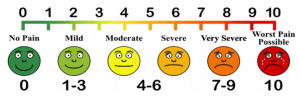
The first and most fundamental approach to helping children manage procedural anxiety is empathetic listening. Validating a child’s emotions and reactions—rather than minimizing them or immediately offering solutions—helps the child feel understood. For example, instead of saying, “It’ll be over soon,” a caregiver might say, “It’s scary, but you’re being really brave.” For children with differing communication needs, using visual aids—such as the one below—can also help to assess the child’s comfort level.
Behavioral Interventions
Preparing a child for a procedure can help reduce anxiety and address any preoperative concerns. Strategies may include:
- Family-delivered education through literature and videos
- Visual aids, social stories, or demonstrations using puppets
- Familiarizing the child with the equipment that will be used
- Rehearsing each step of the procedure
Distraction is another commonly used strategy, but the type of distraction matters. Active distractions, such as blowing bubbles or engaging in a virtual reality game, are generally more effective than passive distractions, like watching a video. In addition, offering the child choices in how they want to cope—such as through a coping menu—can provide a sense of autonomy and control over the process.
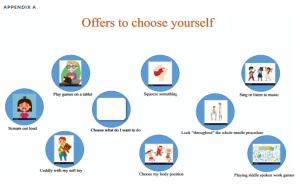
For children who are particularly resistant to undergoing a procedure, the use of praise, sticker charts, or other rewards can increase motivation and help create positive associations with doctor’s visits.
Physical Interventions
Several physical interventions can help reduce procedural anxiety in children. Devices such as the ShotBlocker and Buzzy provide targeted physical stimulation to distract from injection pain. Acupressure has also been shown to be effective for reducing nausea and alleviating muscle tension. Additionally, simple comfort measures, such as heated pillows or the use of calming scents like lavender oil, can promote relaxation during procedures.
Conclusion
Overall, effective management of procedural anxiety in children typically involves a combination of the following strategies (Hu et al., 2024; Kain et al., 2007):
- Preparing the child for the procedure through education, familiarization, and rehearsal
- Involving caregivers who can provide emotional support and model calm behavior
- Providing options for distraction tailored to the child’s age, preferences, and communication needs
- Maintaining communication and rapport to ensure the child feels heard, understood, and supported throughout the procedure
- Offering praise and reinforcement, when appropriate, to encourage positive coping and association with medical procedures
By integrating these strategies, healthcare professionals can help minimize anxiety and provide comprehensive support to both children and their caregivers during medical procedures.
Resource
Several organizations and programs provide support and resources to help children cope with procedural anxiety, one of which is Matio – Kids Kicking Cancer. This program uses martial arts-based programs to empower children facing medical procedures and chronic illness. Through guided breathing techniques, visualization, and movement, the program helps children manage pain, reduce stress, and build confidence during hospital visits. Programs like this not only provide practical coping strategies, but also foster emotional resilience, giving children and their families tools to navigate medical procedures more positively.
References
Aarts, L. A. M., van Geffen, G., Smedema, E. A. L., & Smits, R. M. (2023). Therapeutic communication improves patient comfort during venipuncture in children: a single-blinded intervention study. European Journal of Pediatrics, 182(9), 3871-3881. https://doi.org/10.1007/s00431-023-05036-7
Borge, L. M., & Svendsen, E. J. (2025). Use of rewards for children in hospitals – experiences from pediatric nurses: A qualitative interview study. Journal of Pediatric Nursing, 83, 96. https://doi.org/10.1016/j.pedn.2025.04.029
Chow, C. H. T., Van Lieshout, R. J., Schmidt, L. A., Dobson, K. G., & Buckley, N. (2016). Systematic review: Audiovisual interventions for reducing preoperative anxiety in children undergoing elective surgery. Journal of Pediatric Psychology, 41(2), 182. https://doi.org/10.1093/jpepsy/jsv094
Chrisler, A. J., Claridge, A. M., Staab, J., Daniels, S. R., Vaden, V., & McTaggart, D. (2021). Current evidence for the effectiveness of psychosocial interventions for children undergoing medical procedures. Child: Care, Health & Development, 47(6), 782. https://doi.org/10.1111/cch.12900
Christian, B. J. (2025). Translational research: Innovative intervention strategies for promoting child and adolescent health and improving the quality of pediatric nursing practice. Journal of Pediatric Nursing, 30(2), 410. https://doi.org/10.1016/j.pedn.2015.02.004
Fusetti, V., Re, L., Pigni, A., Tallarita, A., Cilluffo, S., Caraceni, A. T., & Lusignani, M. (2022). Clown therapy for procedural pain in children: A systematic review and meta-analysis. European Journal of Pediatrics, 181(6), 2215-2225. https://doi.org/10.1007/s00431-022-04440-9
Gerçeker, G. Ö., Salmal, N., & Bektaş, İ. (2025). The effect of active and passive virtual reality distractions on phlebotomy-related emotional behavior, pain, anxiety, and fear in children: A randomized controlled trial. Journal of Pediatric Nursing, 83, 190. https://doi.org/10.1016/j.pedn.2025.05.005
Gjærde, L. K., Hybschmann, J., Dybdal, D., Topperzer, M. K., Schrøder, M. A., Gibson, J. L., Ramchandani, P., Ginsberg, E. I., Ottesen, B., Frandsen, T. L., & Sørensen, J. L. (2021). Play interventions for paediatric patients in hospital: A scoping review. BMJ Open, 11(7), e051957. https://doi.org/10.1136/bmjopen-2021-051957
Guillari, A., Giordano, V., Catone, M., Gallucci, M., & Rea, T. (2024). Non-pharmacological interventions to reduce procedural needle pain in children (6-12 years): A systematic review. Journal of Pediatric Nursing, 78, e102. https://doi.org/10.1016/j.pedn.2024.06.025
Hedén, L., Von Essen, L., & Ljungman, G. (2009). Randomized interventions for needle procedures in children with cancer. European Journal of Cancer Care, 18(4), 358. https://doi.org/10.1111/j.1365-2354.2008.00939.x
Hosseini, S. J., Yousefabady, M. A., Hosseini, S. R., & Firooz, M. (2025). Effect of acupressure on venous access procedural pain in children: A systematic review and meta-analysis. Complementary Therapies in Medicine, 93, 103219. https://doi.org/10.1016/j.ctim.2025.103219
Hu, W., M.D., Jia, J., B.D., & Zhao, L., M.D. (2024). Intervention strategy for anxiety behaviors in children in perioperative period of outpatient surgery: Process formulation and implementation effects. Alternative Therapies in Health and Medicine, 30(7), 279-283. http://msp.idm.oclc.org/login?url=https://www.proquest.com/scholarly-journals/intervention-strategy-anxiety-behaviors-children/docview/3107463529/se-2
Kain, Z. N., Caldwell-Andrews, A. A., Mayes, L. C., Weinberg, M. E., Wang, S., MacLaren, J. E., & Blount, R. L. (2007). Family-centered preparation for surgery improves perioperative outcomes in children: A randomized controlled trial. Anesthesiology (Philadelphia), 106(1), 65. https://doi.org/10.1097/00000542-200701000-00013
Kashouty, R. (2024, May 1). The neurology of pain: How our brains interpret pain – premier neurology & wellness center. Premier Neurology & Wellness Center. https://premierneurologycenter.com/blog/the-neurology-of-pain-how-our-brains-interpret-pain/
Kleye, I., Hedén, L., J Sundler, A., Darcy, L., van Dulmen, S., & Karlsson, K. (2025). Increasing child involvement by understanding emotional expression during needle procedures: A video-observational intervention study. Journal of Pediatric Nursing, 81, e24. https://doi.org/10.1016/j.pedn.2025.01.026
Kleye, I., Sundler, A. J., Karlsson, K., Darcy, L., & Hedén, L. (2023). Positive effects of a child-centered intervention on children’s fear and pain during needle procedures. Paediatric & Neonatal Pain, 5(1), 23-30. https://doi.org/10.1002/pne2.12095
Li, W. H. C., Chung, O. K. J., Chen, H., & Xiao, S. (2025). Understanding the perceptions, behavior, and attitudes of healthcare professionals, hospitalized children, and their parents toward hospital play services: A mixed-methods approach. Journal of Pediatric Nursing, 83, 38. https://doi.org/10.1016/j.pedn.2025.04.024
Martin, S. R., Bauer, K., Heyming, T. W., Zhu, J., Lee, H., & Kain, Z. N. (2025). Incidence and predictors of nonresponse to intranasal midazolam in children undergoing laceration repair. Academic Emergency Medicine, 32(7), 768-775. https://doi.org/10.1111/acem.15106
Marusak, H. A., Borg, B., Morales, A., Carrington Smith, J., Blankenship, K., Allen, J. L., Goldberg, E., & Bluth, M. H. (2022). Martial arts-based curriculum reduces stress, emotional, and behavioral problems in elementary schoolchildren during the COVID-19 pandemic: A pilot study. Mind, Brain, and Education, 16(1), 5-12. https://doi.org/10.1111/mbe.12307
Veeravalli, S., Michaud, M., Colton, J., Bourdeau, B., Sacks, S., Hales, L., Guadagno, E., & Poenaru, D. (2025). Adapting perioperative care for neurodivergent children – A scoping review. Journal of Pediatric Surgery, 60(5), 162224. https://doi.org/10.1016/j.jpedsurg.2025.162224
Wickramasinghe, R., & McLean, G. (2025). Improving procedure completion and engagement of neurodivergent patients in medical imaging: A systematic review. Journal of Medical Radiation Sciences. https://doi.org/10.1002/jmrs.70023