
February 13, 2026
Meltdown, Burnout, or Shutdown: Understanding Emotional Overload
By: Kamila Charles, MSW Intern and Juno Ottathengil, LLMSW
Introduction
Emotional overload is something that anyone can experience in today’s fast-paced world. Some may wonder what it actually looks like and how families and communities can support individuals experiencing it. This blog breaks down the science, signs, and strategies for responding to the three stress responses of emotional overload: meltdown, burnout, and shutdown.
What Happens in the Brain and Body?
When we encounter overwhelming stress, our brains trigger the fight, flight, or freeze response. This happens when the amygdala (“threat detector”) activates, ramping up our sense of danger and dialing down our ability to regulate behavior. Physiological signals, such as rapid heart rate, shallow breathing, muscle tension, or sweating, accompany this process. If stress is chronic, it can lead to dysregulation and long-term exhaustion, which is what is commonly known as burnout. Behavioral outcomes can include expressive meltdowns, quiet shutdowns, or fatigue-filled disengagement.
Signs and Causes of Each Stress Response
Meltdown: An intense, short-term burst of emotion due to overwhelming stimuli.
- Signs: Crying, screaming, hitting, or pacing, all which are often sudden and situational.
- Causes: Overstimulation, unmet needs, and sensory overload.
Burnout: A chronic exhaustion that builds up over time due to persistent stress.
- Signs: Withdrawal, irritability, fatigue, and trouble completing tasks.
- Causes: Ongoing demands, emotional labor, and lack of support.
Shutdown: A short-term freeze response where engagement drops off.
- Signs: Minimal interaction, withdrawal, and quietness.
- Causes: Immediate overwhelm and need for safety.
Ways to Support Individuals (Read from Left to Right)
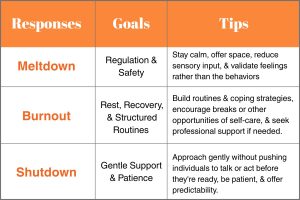
Parent Takeaways
- Stay calm and empathetic.
- Avoid punishment or shame.
- Communicate about feelings when the child is in a regulated state.
- Provide predictable routines and breaks.
Support & Resources
Emotional overload isn’t something to tackle alone. Community resources such as local mental health centers, counseling services, youth crisis hotlines, and online support networks can make a difference.
- Community Resources: U-M Psychiatric Emergency Services, Washtenaw CMH, and Ozone House (Local resources for urgent and ongoing support).
- Online Support Networks: Teen Line, Trevor Project, SAMHSA Helpline, 7 Cups, and Crisis Text Line (Confidential support for overwhelming stress and emotional needs).
Conclusion
Understanding meltdown, burnout, and shutdown starts with recognizing the signs and causes of emotional overload. Effective strategies, such as staying calm, reducing stimulation, and building routines, help provide safety and support. Additionally, collaboration between families and professionals reduces shame, fosters understanding, and promotes positive outcomes.
References
Cannon, W. B. (1932). The wisdom of the body. W. W. Norton & Company.
McEwen, B. S. (2017). Neurobiological and systemic effects of chronic stress. Chronic
Stress, 1, 1-11. https://doi.org/10.1177/2470547017692328
Sapolsky, R. M. (2004). Why zebras don’t get ulcers: The acclaimed guide to stress, stress-related diseases, and coping. Holt Paperbacks.