
July 18, 2025
The Importance of Building Rapport with Autistic Clients
By: Zachary Burton, MSW Intern and Juno Ottathengil, LLMSW
Clinical practice is in constant evolution: Methods and recommendations that were the norm 40 or 50 years ago are completely different today. One of those recommendations was that practitioners should fight against negative feelings of guilt, shame, and ambivalence when working with individuals using substances in addiction treatment. This has radically changed over time, and the current norm is to work alongside the client, rather than demonize their negative or ambivalent emotions towards their situation. Another past recommendation was that building rapport with autistic clients was unfeasible, or at least not worth the trouble for the practicing clinician. Behavioral interventions were given priority, as rapport building was framed as unreasonably difficult due to the language and communicative abilities of the client (which were often framed in deficit-centric language).
After decades of progress, autistic voices are finally being heard, integrated, and involved in professional practice. The “Double Empathy Problem” helps to elucidate how the burden of adapting to communication differences has been overwhelmingly placed on autistic individuals, when allistic (non-autistic) individuals could also be making beneficial communication adaptations. Rapport building, something considered essential when supporting any allistic client, is now being acknowledged as important across the neurodiverse spectrum. One thing is certain: clinicians are fully capable of building strong relationships with their autistic clients with the right guidance and information.
Points of Focus
When looking to support an autistic client (or any allistic clients), it’s helpful to look back on the work of humanist psychologist Carl Rogers for guidance. A pioneer of person-centered therapy, Carl Rogers focused on establishing a positive, effective, and warm therapeutic relationship with clients. Consider how you can embody these three pillars in your own practice to create an effective therapeutic bond with your clients.
- Congruence
- Being genuine and engaging with what clients find important.
(Example: Being honest with your knowledge level regarding objects or activities of interest.)
- Being genuine and engaging with what clients find important.
- Empathy
- Perspective-taking and communicating understanding.
(See: Double Empathy Problem)
- Perspective-taking and communicating understanding.
- Unconditional Positive Regard
- Offering warm acceptance of client’s interests and experiences.
Ideas to Get the Creative Juices Flowing
While this blog won’t go into depth about specific evidence-based rapport building strategies to use in your clinical practice, we want to emphasize the importance of developing your own strategies that align with how you already conduct sessions. To help kickstart the brainstorming process, take a look at some of these rapport-building strategies that focus around integrating the client’s special interest into treatment. Use this as an opportunity to think of how you might integrate special interests into your practice and synthesize those topics with therapeutic content.
Mini Mission
- Identify a “name” or “general topic” related to the client’s special interest during the session.
Examples: “Miami Hurricanes” or “Talking Heads” - Look up a singular Wikipedia article or short Youtube video related to the topic.
- Note two things you learned or noticed.
- Optional: Report back in the next session with your new knowledge.
The point of this “Mini-Mission” is to demonstrate your investment in your client, to your client. By building knowledge about your client’s special interest in manageable chunks, you also increase your own ability to navigate these topics and transition when necessary.
Trust Building
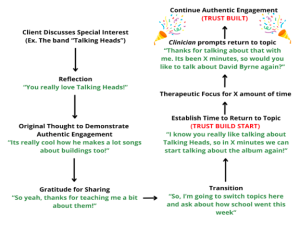
When supporting a client with low engagement in therapeutic or modality-related content, and who uses talking about a special interest to calm themselves, this trust-building exercise was created. In an allistic world, our clients may not have opportunities to talk about their interests freely in a safe context. Ideally, therapy should provide that safe space, in which both practitioner and client can discuss these topics without fear of getting shut down by the other person.
However, this may also make it difficult for the client to focus on topics such as coping strategies, social skills, and decision-making. Through authentic engagement and building, this script aims to show the client that the “conversation ball” will be thrown back to them. Therefore, the client is less preoccupied with regaining control of conversation, and can instead feel secure in knowing that control will be given back to them.
As you look at this model, think about how you build trust and rapport with your client. Write down your own personal script, noting the function of each step of your approach!
Conclusion
The rapport-building process is essential for any clinician looking to create a strong therapeutic relationship with their clients. However, it is only the first step of effective practice. Clinicians will have to capitalize on this strong foundation connecting the client to helpful resources, psychoeducation, and providing cooperative care.
References
Hume, R. (2022). Show Me the Real You: Enhanced Expression of Rogerian Conditions in Therapeutic Relationship Building with Autistic Adults. Autism in
Adulthood, 4(2), 151–163. https://doi.org/10.1089/aut.2021.0065
Rifai, O. M., Fletcher-Watson, S., Jiménez-Sánchez, L., & Crompton, C. J. (2022). Investigating Markers of Rapport in Autistic and Nonautistic Interactions.
Autism in Adulthood: Challenges and Management, 4(1), 3–11. https://doi.org/10.1089/aut.2021.0017
Taylor, B. A., & Fisher, J. (2010). Three Important Things to Consider When Starting Intervention for a Child Diagnosed With Autism. Behavior Analysis in
Practice, 3(2), 52–53. https://doi.org/10.1007/BF03391765
Wampold, B. E. (2001). The great psychotherapy debate: Models, methods, and findings (pp. xiii, 263). Lawrence Erlbaum Associates Publishers.